





Latest News
- Victim's family outraged; Ryden Bragden's killer will not go to prison
- Increase in advanced prostate cancer; alarm bell for reconsideration of men's screening
- John Rusted removed from leadership of British Columbia's Conservative Party, but says she has no intention of leaving(مؤنث)
- New tax credit: Saving the oil industry or betraying the environment?
- At the height of "America First" policy, ICE went after Canadian manufacturer
Latest Ads
-
Jasmine Jewel
Call

-
Omidan group
Call

-
Amir Madanpour
Call

-
Dimo studio
Call

-
Yorkacademy
Call

-
Maryambagheri
Call

-
Shishlix Restaurant
Call


 283 View
 550 View
 129 View
 399 View
 185 View
 215 View
 363 View
 373 View
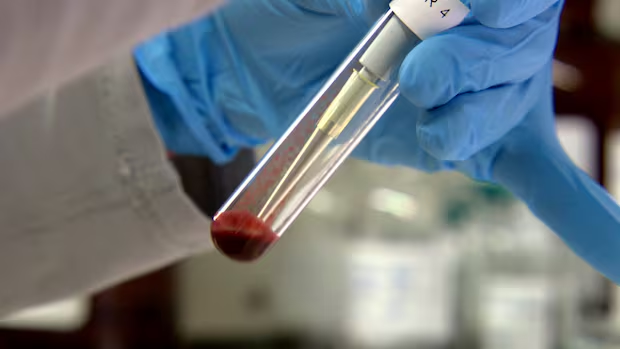
Increase in advanced prostate cancer; alarm bell for reconsideration of men's screening
New study suggests rising cases of incurable prostate cancer may be the result of declining early screening
But some experts still believe the harms of screening outweigh the benefits
A new study suggests that a spike in cases of stage IV prostate cancer — the stage at which the disease is usually incurable — could signal a need to rethink screening policies for this common cancer among men.
The study, published in the journal Current Oncology, examined decades of data on prostate cancer incidence and mortality and found that rates of advanced cancer have increased, while the decline in mortality — which had been declining for years — has stalled.
“Although we didn’t know who was being screened, the large amount of data allows us to draw some conclusions about the consequences of screening or not screening,” says lead author Dr. Anna Wilkinson, a family physician at the University of Ottawa.
Experts disagree
However, some oncologists say the results are being misinterpreted and that the screening blood test — the PSA test — is not accurate enough and may lead to overdiagnosis and unnecessary treatment.
Changes in screening
The Canadian Prevention Task Force has never recommended prostate cancer screening.
But in the 1990s, the United States approved the use of the PSA test, which led to its widespread use in Canada. Then, in the early 2010s, the United States reversed its policy, and both countries moved toward not recommending screening. The change provided an opportunity for researchers to examine how the policy change affected incidence and mortality rates.
According to the study findings:
From 2010 to 2021, cases of stage 4 prostate cancer increased by about 50 percent in men aged 50 to 74;
In men aged 70 and older, the increase was about 65 percent.
The study also found that mortality rates fell when screening became more common; but after screening recommendations were stopped, the trend almost leveled off.
But some experts disagree.
Dr. Bishal Gyawali, an oncologist at Queen’s University, believes the decline in mortality rates is more a result of advances in treatment than screening.
“Death rates are still falling regardless of what the screening recommendations are,” he says.
James Dickinson, a family medicine specialist and a staunch opponent of PSA testing in Canada, also says the rise in stage 4 cases is partly a result of improved imaging technology and partly a result of less screening:
“When screening is reduced, fewer cases are found early, and most patients are identified when they have symptoms — in the more advanced stages.”
PSA test: simple but controversial
The PSA test measures the amount of a protein produced by the prostate, and an elevated level can indicate a problem. But it’s not accurate and can produce false positives.
Researchers believe this could lead to patients going through a cycle of more detailed, riskier tests — such as MRIs or biopsies — that are both expensive and invasive.
On the other hand, many surgeries or treatments can cause side effects, such as urinary incontinence or sexual dysfunction.
That's why some experts say we need a more accurate test to distinguish dangerous cancers from slow-growing, harmless ones.
New approaches: Diagnosis separate from treatment
Wilkinson says there have been advances in recent years to reduce the harms of treatment.
One such advancement is "active surveillance," where a low-risk patient is simply monitored and not necessarily treated immediately.
A patient's story
Dennis Farbstein, 72, has a different personal story. He started getting PSA tests at age 48 and was monitored and tested for about six years.
He eventually had surgery and has been cancer-free for nearly two decades.
"If I hadn't been screened, the cancer could have spread and become life-threatening. So for me, screening was a good thing."
But experts say the problem is that people—even those who have endured long-term side effects from unnecessary treatments—still see screening as the right decision.
The future of screening guidelines
After a major overhaul of the structure of the Canadian group that sets screening guidelines, new guidelines have been put on hold — including those being developed for prostate cancer.
The Canadian Cancer Society and the Canadian Urological Association recommend that PSA testing be done only after discussing the benefits and risks with a doctor.
News source
Suggested Content
Latest Blog






Login first to rate.
Express your opinion
Login first to submit a comment.
No comments yet.