




Latest News
- At the height of "America First" policy, ICE went after Canadian manufacturer
- Snowy winter brings new hope for Canadian ski resorts
- Murder charges rise among Canadian teens despite overall murder rate decline
- Algoma Steel CEO: Federal government knew about layoffs before providing $400 million loan
- Online banking scam leaves Winnipeg woman with $174,000 in debt
Latest Ads
-
Jasmine Jewel
Call

-
Omidan group
Call

-
Amir Madanpour
Call

-
Dimo studio
Call

-
Yorkacademy
Call

-
Maryambagheri
Call

-
Shishlix Restaurant
Call


 63 View
 397 View
 424 View
 308 View
 223 View
 142 View
 259 View
 219 View
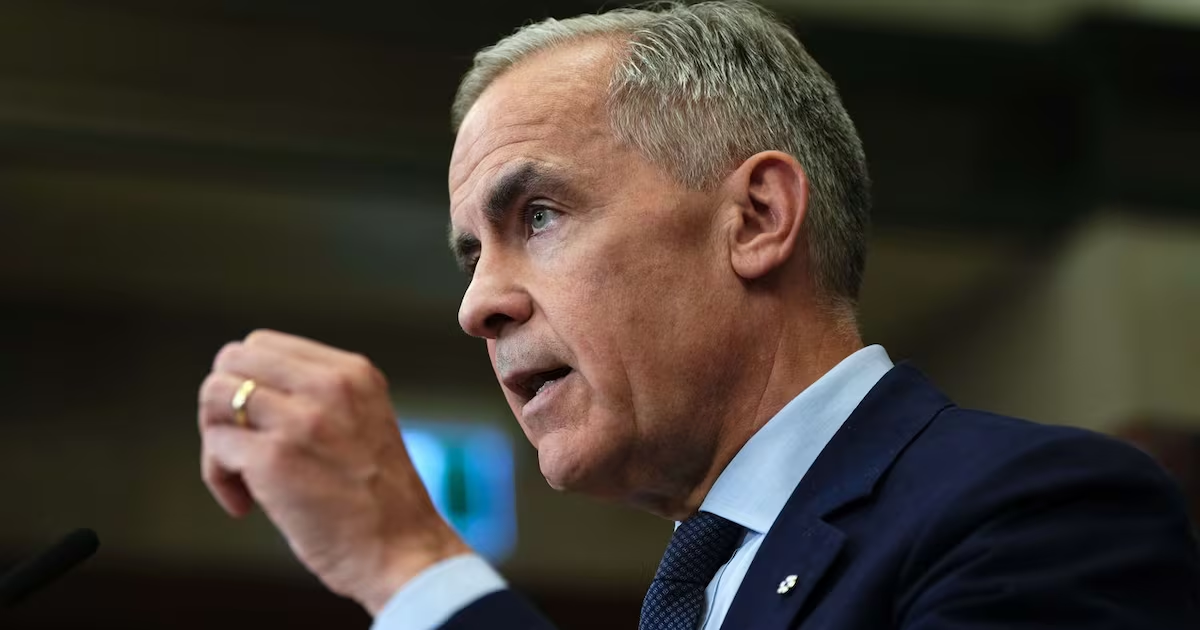
Algoma Steel CEO: Federal government knew about layoffs before providing $400 million loan
Algoma Steel CEO Michael Garcia discusses the timing of the layoffs, the fight against Trump’s tariffs and whether the federal government knew about the layoffs.
Algoma Steel’s president says the federal and Ontario governments knew the company’s business plan included a restructuring of its Sault Ste. Marie mill that would result in layoffs before they agreed to a half-billion-dollar loan to help the company weather the U.S. tariff crisis.
The company, Canada’s last independent steelmaker and employing about 2,700 people in the northern Ontario city, issued layoff notices to about 1,000 workers on Monday; the layoffs will take effect in March.
Algoma Steel was hit hard by the 50 per cent steel tariffs that U.S. President Donald Trump imposed in June.
The adjustments come less than a month after the company announced it had finalized $500 million in financing deals with the federal and Ontario governments, with the federal government providing $400 million and the Ontario government providing $100 million.
Speaking on CTV’s Power Play, Garcia said it had been a “very challenging and bittersweet week” for Algoma Steel and that the entire company had been “a few months” in the making of its strategy if the tariffs were not lifted.
Starting in 2021, the steelmaker is transitioning to an electric arc furnace (EAF) steelmaking system, a method Garcia sees as more cost-effective, flexible and less labour-intensive. The change also means the closure of its blast furnace and coke-making operations.
Garcia explained to host Vasi Kaplos that reducing headcount at Algoma Steel “has always been the future of the company.” He said only 1,600 employees are needed to start up the electric furnaces, which can produce 3.2 million tonnes of steel, compared to 3,000 employees needed to produce 2 million tonnes using a blast furnace.
However, the timeline for the transition has been accelerated by unprecedented U.S. tariffs that have effectively closed the country’s market to Canadian steel.
“We expected the transition to happen in early or late 2027, but with the changes that are happening now and the markets we have access to are severely limited by the U.S. tariffs, the future has come sooner for Algoma Steel,” he said. He added that without the acceleration and without funding from the federal and provincial governments, the company would not have been able to continue operating.
When asked by Caplos if Ottawa and Ontario knew the layoffs were coming before they agreed to the half-billion-dollar loan, Garcia said, “The government is certainly aware of our business strategy.”
“They were aware of the change we had to make. They knew very well how much pressure the company was under. I don’t think anyone would lend half a billion dollars without asking very specific questions about our business plan,” Garcia said. Garcia added that he had been very transparent with both the government and the employees about the company’s future plans.
“I think the main concern is how do we protect the continued existence of Algoma Steel? How do we make sure it remains competitive and sustainable?”
On Tuesday, Industry Minister Melanie Joly told reporters that her thoughts and prayers are with the laid-off workers and their families.
“We will continue to work to save these jobs. We will work with the union and the company to make sure that the future is brighter for workers and the steel industry.”
Joly said the federal government has partnered with Algoma Steel to build a new steel beam mill and a steel plate mill, and he believes the investments will help bring jobs back.
Garcia also acknowledged that the investments could create 400 to 500 new jobs in the coming years, but stressed that they will not replace the jobs that have been lost.
“Once we close the blast furnace and the coke ovens, those jobs are not coming back. Those operations are no longer there,” he said.
Asked if he believes Algoma Steel is still a viable company, Garcia said “yes,” but “it takes effort.”
“We have the manpower to do it right, and I also hope the government continues to take steps to create a fair and competitive market for domestic steelmakers,” he said.
Looking ahead, he says domestic steelmakers need to dominate the domestic market, but he is eager to see trade relations with the United States return.
“This is an important part of the future of the Canadian steel industry,” he said. “When trade relations with the United States improve and we have greater access to the American market, we will certainly take advantage of that. But we will never lose sight of the fact that we need to build the company on a strong presence in the domestic market.”
News source
Suggested Content
Latest Blog





Login first to rate.
Express your opinion
Login first to submit a comment.
No comments yet.