





Latest News
- Rare adoption of a polar bear cub near Churchill confirmed by scientists
- Alberta closes supervised drug use centre at Edmonton hospital
- These maps show how the pre-Christmas storm is sweeping across Canada
- Meta has discontinued the Messenger desktop app.
- What we know about Nick Reiner, son of Rob and Michelle Reiner
Latest Ads
-
Jasmine Jewel
Call

-
Omidan group
Call

-
Amir Madanpour
Call

-
Dimo studio
Call

-
Yorkacademy
Call

-
Maryambagheri
Call

-
Shishlix Restaurant
Call


 2519 View
 524 View
 380 View
 255 View
 255 View
 236 View
 237 View
 188 View
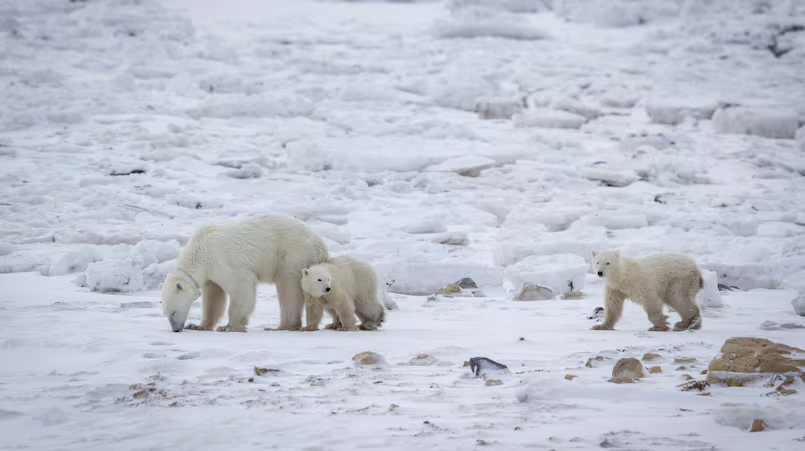
Rare adoption of a polar bear cub near Churchill confirmed by scientists
Scientists studying polar bears were in for a surprise during a tracking mission in northeastern Manitoba.
In mid-November, a female polar bear was spotted with her cub near the town of Churchill, but researchers discovered she was carrying a second cub, which they later determined was not her own. This is only the 13th recorded adoption of a bear cub in the western Hudson Bay polar bear population.
“When it was confirmed that this was an adoption, I had mixed feelings, but mostly positive ones,” Alyssa McCall, director of conservation communications and a researcher at Polar Bears International, said in a video released to the media.
“It just goes to show how amazing and fascinating this species is, and it gives you a lot of hope that polar bears might be looking out for each other,” McCall said in a video released to the media.
Evan Richardson, a polar bear researcher with Environment and Climate Change Canada, was in the area in March. His team spotted the female bear leaving her den in Wapusk National Park, south of Churchill.
At the time, the female was accompanied by just one cub. But in the fall, Richardson was surprised to see that the family of two had grown into a family of three. Two of the bears had previously been fitted with GPS collars, but the new cub did not.
“This is not a very common occurrence,” Richardson said. “In our long-term study over the past 45 years, we have identified more than 4,600 bears individually, and hundreds and hundreds of births have been recorded, but adoptions have been very rare.”
The researchers estimated the female bear to be about five years old, and the two cubs to be between 10 and 11 months old.
Richardson doesn’t know the exact reason for the adoption, but he has a theory:
“We really think it’s because polar bears have a very strong maternal instinct and are great mothers. They probably can’t leave a cub crying alone on the tundra, so they take it with them.”
Polar bear cubs typically stay with their mothers for two to two and a half years.
“That’s not a long time to learn how to live as a polar bear, but they learn a lot in that time,” McCall explained. “The survival rate to adulthood is about 50 percent, but if a cub doesn’t have a mother, it has almost no chance.”
The adopted cub now has a good chance of making it to adulthood, he said.
It’s not yet clear what happened to the cub’s biological mother, but Richardson hopes genetic samples his team took from the cub will provide clues.
Environment and Climate Change Canada, in partnership with Polar Bears International and the University of Alberta’s Polar Bear Science Program, collects data on the bears through GPS collars, and some of their movements can be tracked online.
Female bears in the western Hudson Bay region have been fitted with GPS collars for decades, McCall said, but only about 10 bears receive one each year. However, adopting a cub is a rare occurrence, and seeing one up close is even rarer.
“With climate change, bears need all the help they can get these days,” Richardson said. "The fact that a female bear can adopt another cub, care for it, and successfully raise it is a good thing for Churchill bears."
News source
Suggested Content
Latest Blog






Login first to rate.
Express your opinion
Login first to submit a comment.
No comments yet.